Construction Site First Aid Requirements: Numbers, Courses and Kit
Ask three site managers how many first aiders the law requires on a construction site and you will get three different numbers, each delivered with total confidence. There is a reason for that: the Health and Safety (First-Aid) Regulations 1981 never name one. What the regulations require is "adequate and appropriate" first aid equipment, facilities and personnel from every employer, and "adequate" is yours to work out.
So construction site first aid requirements rest on one document: a first aid needs assessment for your site. The good news is that HSE guidance gives you plenty to anchor it to, and it treats construction as higher-hazard work throughout. The bad news is that a site running on "we've got a green box in the cabin somewhere" has not met the requirement, however well stocked the box is.
Construction Site First Aid Requirements Hinge on the Needs Assessment
Managing compliance in a spreadsheet?
ComplianceVault replaces the scramble. Free to get started, no card needed.
A needs assessment for a construction site weighs factors that an office assessment never has to think about:
- Headcount, including peaks. A site averaging 20 operatives might carry 60 during the fit-out rush. Assess for the peak, not the average.
- The hazards on the programme. Excavations, hot works, plant movements, temporary electrics. The nastier the plausible injury, the stronger the provision needs to be.
- How spread out the work is. A first aider in the site office is little use to someone bleeding on level four of the far block. Big or split sites usually need cover in more than one place.
- Lone and out-of-hours working. The watchman doing a Sunday walk-round has no colleague to shout for. Your assessment has to say what happens then.
- Distance from help. A rural barn conversion forty minutes from the nearest A&E needs more capable first aiders than a job next door to a hospital.
Work at height deserves its own line in the assessment, because getting a first aider to a casualty on a scaffold or roof is a plan in itself. It sits alongside the rescue planning the Work at Height Regulations already demand.
The duty itself sits in an odd place. The 1981 Regulations put it on each employer for their own employees, and self-employed workers must arrange their own provision. Taken literally, a shared site would run fifteen overlapping arrangements, which is why the principal contractor normally coordinates first aid for everyone and records it in the construction phase plan. Sensible, and what the vetting portals expect to see.
Appointed Person, EFAW or FAW: The Tiers Explained
Three levels of person appear in the guidance, and they are frequently muddled.
An appointed person is the legal minimum. They take charge when someone is hurt, look after the kit and call 999. No formal training is required, though half-day courses exist and are worth the money. An appointed person is not a first aider and should not attempt treatment they have not been trained to give.
Emergency First Aid at Work (EFAW) is the one-day course, six hours of contact time, covering the emergency basics. The certificate lasts three years.
First Aid at Work (FAW) is the three-day course. It covers everything in EFAW plus a wider range of injuries and illnesses, which is why HSE guidance points higher-hazard workplaces towards it. The certificate also lasts three years, and a two-day requalification course is available if you rebook before it lapses. HSE strongly recommends annual refreshers in between; skills fade faster than certificates do.
For higher-hazard workplaces such as construction, HSE guidance suggests the following. These are suggestions to inform your assessment, not legal minimums:
| Workers on site | HSE suggested provision |
|---|---|
| Fewer than 5 | At least one appointed person |
| 5 to 50 | At least one first aider with EFAW or FAW, depending on the injuries that could occur |
| More than 50 | At least one FAW first aider for every 50 workers, or part of 50 |
Treat those numbers as a floor and stress-test them against reality. Holidays, sickness, night shifts and early finishes all punch holes in cover. If your only first aider leaves at four and the follow-on trades work through to six, those two hours belong to a site with no cover, whatever the assessment says.
Kits, Eyewash and Facilities on Site
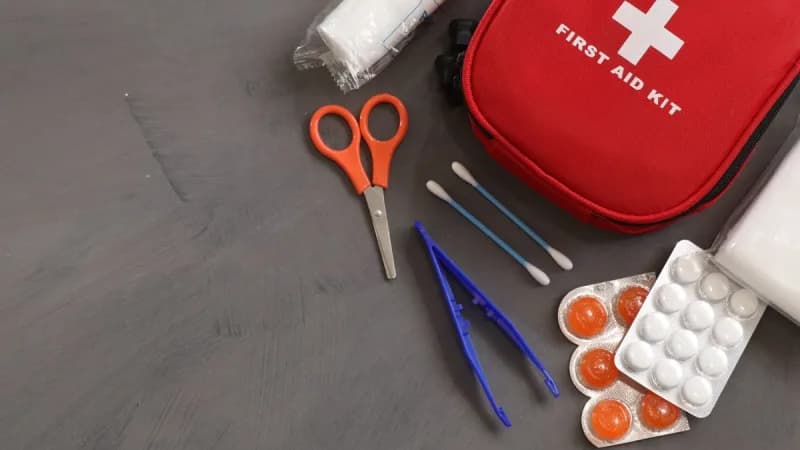
There is no legally fixed contents list for a first aid kit. The benchmark is BS 8599-1:2019, the British Standard for workplace first aid kits, which comes in sizes matched to workforce and risk. Buying kits marked to that standard, and naming it in your written arrangements, saves an argument with an auditor later.
Eyewash matters more on construction sites than people expect, because early-phase sites often have no plumbed water. Where mains tap water is not readily available, HSE guidance calls for at least one litre of sterile water or sterile normal saline (0.9%) in sealed, disposable containers. Once a seal is broken, the container is done. Bin it.
Kits do not look after themselves, so give the job to a named person who checks them monthly and restocks after every use. Sterile dressings and eyewash carry expiry dates too. A kit full of out-of-date dressings looks compliant right up until someone opens it.
Then tell people the arrangements exist. Cover it at site induction: who the first aiders are and where the kits live. The alarm-raising side should match the emergency procedures in your fire safety plan, so workers learn one way of summoning help rather than two.
First Aid Record Keeping on Site
Nothing in the 1981 Regulations forces you to write the needs assessment down, which is a freedom best ignored. A CHAS or SSIP assessor will ask for it, and main contractors' vetting portals request it by name. "We assessed it verbally" has never once scored a point with either. A quick run through our free readiness checker will show you whether your first aid records would stand up next to the rest of your compliance evidence.
Three record sets follow from the assessment:
- The needs assessment itself, reviewed when the site changes phase. The provision that suited groundworks will not suit a hundred fit-out trades.
- First aid certificates, with expiry dates logged. Three years is short. On any project longer than a couple of years, tickets earned at the start will lapse before practical completion.
- The accident book, kept where workers can reach it. Every entry names an injured person and what happened to them, which is personal data; once a page is filled in it belongs somewhere lockable rather than in a book anyone on site can flick through, and the standard books have tear-out pages for exactly this reason. Keep completed records for at least three years, and remember that serious incidents also trigger RIDDOR reporting, which is a separate duty rather than a second copy of the same form.
The habit that keeps all of this honest is a boring one. A FAW ticket that lapsed last month looks exactly like one with two years left; the difference is a date in small print, and dates in small print get read at audits, not at the gate. So tie the renewals to something you already track: put certificate expiry dates in the same place as your insurance renewals and operative tickets, and book the requalification course when the reminder fires rather than when a client audit finds the gap. Miss the window and the two-day requalification route closes; somebody sits the full three days again. If the tracking itself is the sticking point, ComplianceVault gives each evidence type its own reminder lead time, up to three months ahead of the expiry date.
Related articles



Get compliance tips in your inbox
New guides and checklists delivered when we publish. No spam.
Manage your compliance with ComplianceVault
Store evidence, track expiries, and share compliance packs. Free to get started.